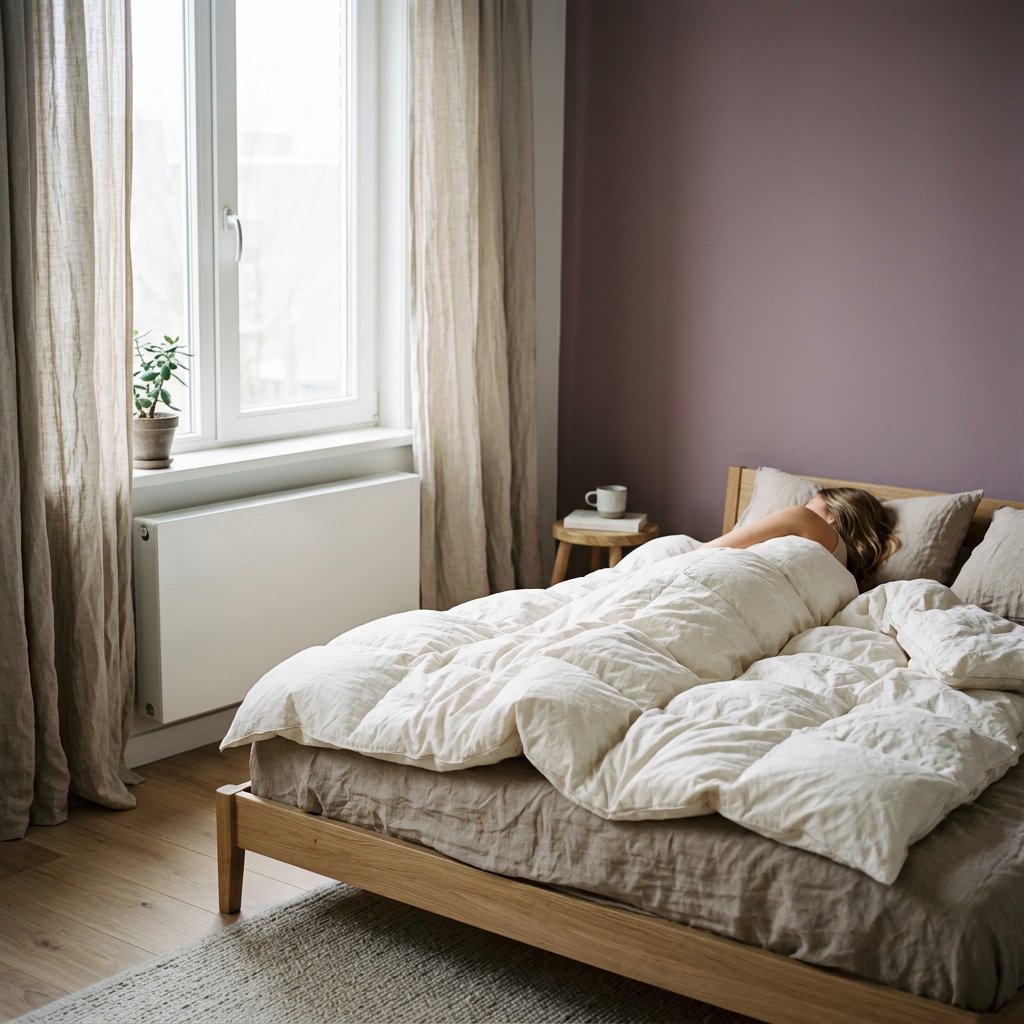

For most adults, the bedroom doesn’t need to be heated all night. Above all, avoid getting too warm while you sleep. Switching off completely doesn’t suit every home, every heating system or every sleeper. So look at three things: the actual room temperature, the indoor climate and the warmth of your bedding.
Why do you often sleep better in a cool bedroom?
A cool bedroom helps your body shed heat as it gears down for the night. Around the time you fall asleep, your core temperature drops. At the same time, your hands and feet release heat through the skin. An environment that’s too warm makes that heat release harder.
Warmth before bed is different from a room that stays warm all night. A warm bed feels cozy when you get in, but that first feeling doesn’t tell you how much warmth you’ll need for the rest of the night.
If heat builds up under your duvet, you may start to sweat, toss and turn or wake up more often. The goal isn’t the coldest possible room, but an environment where you’re comfy without trapping excess heat. Looking for practical tips to stay comfortable in warmer conditions? Check out sleeping better when your home is warm.
What bedroom temperature suits you?
For most adults, about 16–19 °C is a practical starting point; for example, begin around 18 °C. Your warmth needs are personal. So measure near your bed, because the central thermostat doesn’t always reflect the bedroom temperature.
Is 12 degrees too cold? For many people it is. It’s below the usual comfort advice and isn’t a generally recommended energy saving setting. This temperature advice applies to healthy adults. For babies, vulnerable older people and anyone with health issues, follow the health guidelines for their group.
Do you turn the heating off at night or set it lower?
That depends on how quickly your bedroom cools down. The radiator knob controls locally; the central thermostat controls the home’s heating.
| Situation | Suitable night setting | Point to note |
|---|---|---|
| Bedroom stays comfortable | Radiator off or low | No extra heat needed |
| Bedroom cools down significantly | Keep heating at a low level | Avoid an uncomfortably cold room |
| Only cold before bedtime | Preheat briefly with a schedule | Lower the setting afterward |
| Underfloor heating or a slow heat pump system | Limited or no night setback | Follow the system or installer’s advice |
Keep your bedroom fresh without unnecessary cold
- Ventilate continuously and air out briefly before bedtime. See practical tips for ventilating the bedroom. Airing quickly replaces a larger amount of indoor air; ventilation continuously supplies fresh air and removes moisture.
- A window doesn’t have to stay open all night. If that brings in too much cold or noise, use trickle vents or the existing ventilation system for fresh air.
- Keep ventilation openings clear, even if you want to retain heat. Moisture condenses on cold surfaces, such as windows and exterior walls. Prolonged damp spots encourage mold. Ventilation, sufficient heating, and the temperature of those surfaces are connected.
- Warming up can lower relative humidity and irritate dry mucous membranes. Read more about humidity in the bedroom. A dry nose or throat from dry air is different from a viral cold. A humidifier is therefore not an automatic fix for such complaints.
How much does it cost to keep the heating on for an evening or a night?
One fixed amount would be misleading: costs depend on insulation, outdoor temperature, heated space, usage duration, installation, and energy rate. Calculate with actual consumption in m³ of gas or kWh of electricity × the corresponding rate. Nominal device power is not the same as continuous actual consumption.
Less heat loss usually saves energy, reheating does not automatically cancel out those savings. For system dependent settings use the selection table above. Close curtains or shutters to prevent nighttime heat loss, without blocking radiators or ventilation.
Match your duvet to your warmth needs
- A duvet that is too warm traps heat, even in a cool bedroom. Choose the warmth class to match the season and your warmth needs.
- A summer duvet is meant for warm nights; an all season duvet for year round use. A four season duvet consists of two combinable parts, which is not automatically the same as all season. With a 4 season duvet you can fine tune the warmth per night or season.
- The material of your duvet, your fitted sheet and your mattress also affects warmth and moisture comfort. Also read: cooling fitted sheet: when does it really make sense?
- You can use our HappyBed summer duvets and all season duvets without a cover and wash them in the washing machine. Do you get too warm at night? Read more about duvets without a cover for night sweats.
Can you fall asleep in 2 minutes?
No temperature setting or relaxation technique makes everyone fall asleep within two minutes. A comfortable sleep environment does help you unwind, without turning falling asleep into a performance.
Breathe slowly and calmly. Then consciously release the tension in your face, shoulders, hands and legs. Give yourself time for that, without checking the clock all the time.
A warm shower or a warm bath some time before bedtime can be a relaxing ritual. That is different from keeping your bedroom warm all night.