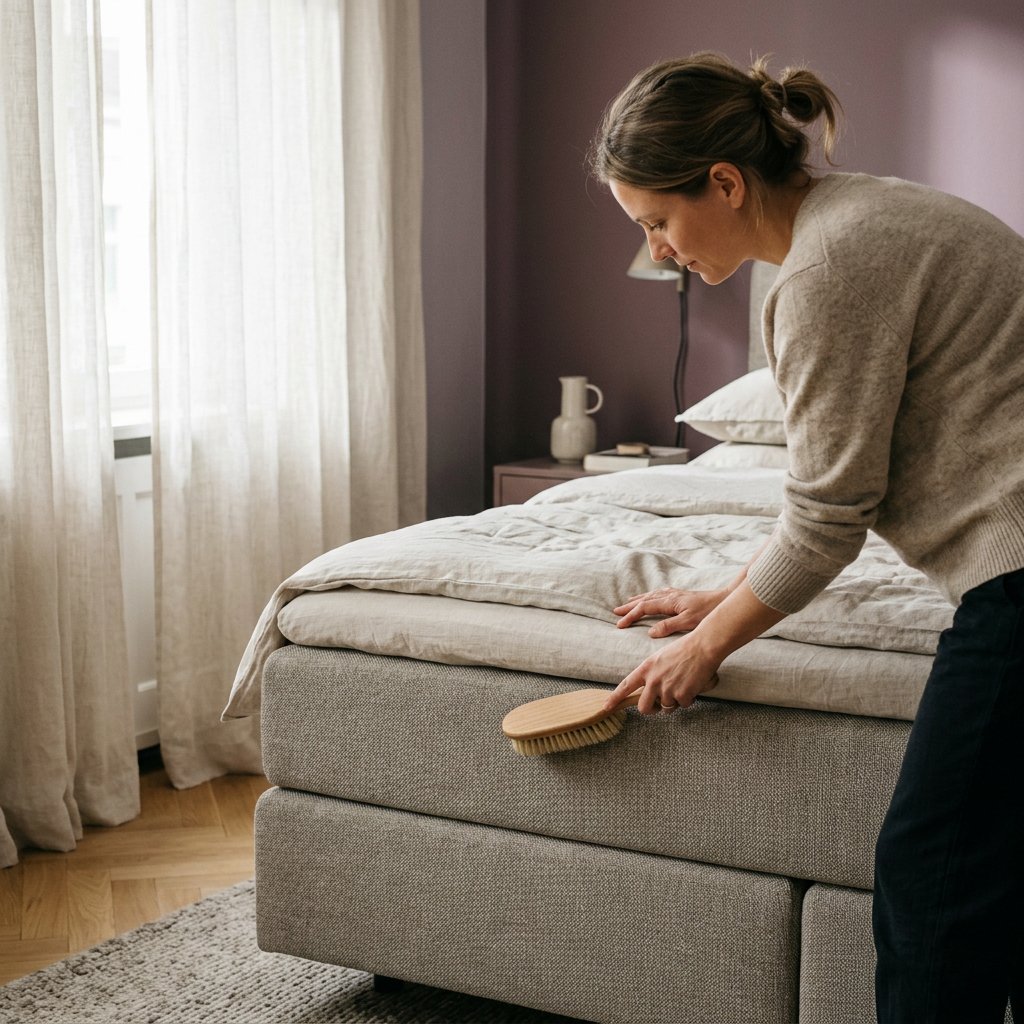

Cleaning a box spring is mainly about dry maintenance and targeted stain removal, not a full wet wash. The upholstered base, headboard, mattress and topper each have their own care guidelines.
Dust, skin flakes and perspiration also end up under fresh bedding. Our machine washable HappyBed duvets go straight in the washing machine, while for the upholstered bed base you keep moisture to a minimum. That way every part gets the care it needs for a fresh, comfortable sleep space.
First inspect the upholstery and the care label
- Let the material and the manufacturer’s care instructions determine how you clean. A woven fabric, velour and faux leather each need a different approach.
- Remove any bedding you plan to wash and make the surfaces you want to clean accessible. Place loose parts in a clean, dry spot without pulling off any fixed upholstery.
- Check the upholstery in good light. Look for discoloration, damaged seams and moisture spots so you do not mistake existing damage for the result of cleaning.
- For an electrically adjustable box spring, follow the manufacturer’s safety instructions. Safely disconnect the power and keep motors, connections and controls dry.
- Leave parts that are not meant to be removed in place. Do not force panels, fittings or finishes.
Choose a cleaner that matches the upholstery
Material suitability comes before choosing between a home remedy and a store-bought product. Use the options below only within the care guidelines. Natural does not automatically mean safe.
| Agent | Application | Main limitation |
|---|---|---|
| Water with mild cleaner | Spot cleaning of water-resistant fabric | Risk of water rings |
| Suitable upholstery cleaner | Targeted stain treatment | Material-dependent formula |
| Baking soda | Dry powder treatment | Powder residue in fabric and seams |
| Vinegar | Acidic cleaning | Risk of rings and discoloration |
| Bleach and harsh products | Unsuitable as the default choice | Damage to color and fibers |
Can you clean your box spring with a steam cleaner?
Use a household steam cleaner only when the manufacturer allows this application. It is not a standard method for an upholstered box spring.
Heat and penetrating moisture can damage the fabric, glue layers and filling. If deeper layers stay damp for a long time, conditions arise that lead to musty odors and mold. A material-appropriate professional treatment is different from DIY steaming: the cleaner matches technique, moisture use and extraction to the furniture’s construction. Steam by itself is not a guarantee of disinfection or complete removal of dust mites.
Remove dust from the fabric base and headboard
- Start at the top of the headboard and work your way down, then do the upholstered sides of the base. Use a clean upholstery nozzle and a suction level that suits the fabric.
- Move smoothly over the upholstery without pressing the nozzle hard. Pay extra attention to seams, buttons, and edges, where loose dirt builds up.
- Do the top edge and the reachable back of the headboard separately. Keep clear of loose threads and damaged fabric.
- Gently loosen pet hair with a suitable soft brush. Brush without hard scrubbing or roughing up delicate fibers.
- Vacuuming removes loose dirt and some allergenic residue, but it does not make your box spring dust-mite free.
How to clean under the box spring too
- Reach the floor with a flat vacuum nozzle. Work from multiple sides to pick up dust along the legs and baseboards.
- Only move the bed as the user instructions allow. Do not lift a heavy box spring on your own and do not tilt it unsafely. Keep cables clear and stay away from moving parts.
- Does your bed have storage? Empty the compartments and vacuum them dry, including along the corners. First remove any loose objects that could block the vacuum.
Treat removable covers and the mattress or topper core separately
A washable cover does not automatically make the inside washable. Treat each part separately.
| Component | Care |
|---|---|
| Removable, washable cover | Machine wash according to the care label. The label determines temperature, program, and drying method. Only put the cover back when it is completely dry. |
| Fixed or non-washable cover | Dry care and allowed spot cleaning. A zipper alone does not mean removal or machine washing is suitable. |
| Mattress or topper core | Keep foam, latex, and other core materials dry. Follow the specific care advice for the core, separate from the cover’s care label. |
Treat stains gently and locally
Treat a stain directly without unnecessarily wetting the surrounding upholstery. This method applies to the base, the headboard, and mattress or topper covers that tolerate spot cleaning.
First test the approved cleaner on a discreet spot and let that test area dry to see its effect on color and texture. Then apply a small amount of cleaner to a clean white cloth, not directly to the fabric. This gives you better control and prevents a colored cloth from bleeding.
Blot gently from the outside in. Scrubbing hard spreads dirt and can damage fibers. Always use a clean part of the cloth and remove product residue according to the instructions.
Tackle sweat, blood, coffee, and wine stains directly
Match the treatment to both the stain and the material.
| Stain type | Material-appropriate approach | Key warning |
|---|---|---|
| Sweat and body oil | Mild upholstery cleaner for greasy and dirty edges, including on the headboard | Old discoloration may remain |
| Blood | Cold water on water-resistant upholstery | Warm water sets proteins; no standard treatment with peroxide or bleach |
| Coffee | Suitable cleaner for colored drink stains | Milk and sugar leave extra residue behind |
| Wine | Textile-safe treatment for wine stains | Salt and vinegar are not a universal solution |
Remove urine without wetting the filling further
- Immediately absorb as much urine as possible with absorbent paper or a clean towel. Let the material take up the liquid without pressing it deeper into the filling. Replace saturated material.
- An enzyme cleaner can be a possible next step against urine odor when the product is suitable for the upholstery in question. Follow the instructions for use and limit the treatment to what the material tolerates.
- Distinguish between a surface spot and urine that has penetrated to the core. A perfume or air freshener masks odor but does not remove the residue left behind.
- To finish up, follow the drying approach below. Deeply absorbed contamination falls under the professional help situations further down.
Let all treated parts dry completely
- Ensure ventilation in the bedroom and free air circulation around the treated areas. Do not use strong local heat from a hairdryer or heater.
- Drying time depends on the material, the amount of moisture and the indoor climate. One fixed waiting time does not suit every box spring.
- Only put covers, protectors and bedding back once everything is completely dry.
- After a lot of liquid, a surface that feels dry says little about the deeper layers. Have persistent moisture assessed by an external specialist.
Freshly made again after cleaning? Here is how to pick the right fit: choosing the right corner height for a box spring fitted sheet.
How often does your box spring need a clean?
Light vacuuming about monthly and a more thorough clean roughly twice a year is a practical baseline, tailored to use and the manufacturer’s advice. Combine the bigger session with attention to the back, the floor under the bed and the condition of the upholstery.
With pets, kids or heavy sweating, more frequent maintenance makes sense. If you are sensitive to allergens, you can schedule vacuuming more often too. A three to four month interval is not a medical standard, so look at the actual buildup and do not automatically blame any allergy symptoms on your bed.
If you see visible stains, spilled liquids or a new, lingering musty smell, do not wait for the next scheduled session. Find the source of the dirt or moisture.
Sagging, broken parts and persistent creaking are other signs. They call for an inspection of the structure and then repair or replacement of the affected part. Extra cleaning agent will not fix these issues.
Keep your box spring fresh between deep cleans
- Air out the bedroom daily and fold back your duvet after getting up. This gives the sleep surface room to release moisture. Keep ventilating during heating season and tackle a persistently damp bedroom at the source.
- Use a washable protector or molton mattress protector between the mattress and the fitted sheet to catch dirt and sweat. A molton is not automatically waterproof; a regular fitted sheet is mainly the soft layer you lie on. Do you have a waterproof version? Read: wash a waterproof molton without damaging the protective layer.
- Choose the right fitted sheet for your topper or the mattress of your box spring. If you have taller mattresses or a thick topper combo, pick a box spring fitted sheet with extra corner height for a snugger fit. Having trouble with slipping sheets? Check out fitted sheet slips off a box spring: causes and fixes.
- Only rotate or flip mattresses and toppers if the manufacturer allows it. This step is not intended for the upholstered bed base.
- Keep food and drinks out of bed. If your pets are allowed on the bed, use a separate washable protector. It catches hair and dirt, but does not make cleaning unnecessary.
When is professional help a good idea?
Calling in an external cleaning specialist is smart for delicate upholstery, deeply absorbed urine, lingering odor or suspected mold. Treating it yourself with more moisture or stronger products can make the damage worse. A specialist can judge whether cleaning is suitable or if a damaged part is better replaced.
Share material details, the care label and clear photos of the soiling. Also describe when the spot appeared, what liquid soaked in and which products you have already used. That information helps choose a treatment that fits the fabric and the layers underneath.
First agree on the right materials, treatment method, expected limits and the drying conditions you’ll need. Also confirm how much space there is around the bed and whether parts are easy to reach. The goal is a tailored approach for your bed, without assuming every stain or smell can be fully removed. If you suspect mold, have the extent and the source of moisture assessed before starting any treatment.