
A storage bed can be a smart solution if you’re short on closet space. Extra blankets, seasonal bedding or suitcases tuck away neatly out of sight, which brings calm to the bedroom. Still, it’s not the most convenient choice for everyone. In daily use many people run into the same drawbacks: more weight, a higher price, more hassle when opening or moving, and extra attention for ventilation and maintenance.
So the real question isn’t just how much stuff fits inside, but whether that hidden storage suits your room and routine. Does it truly help you, or is a regular bed or box spring ultimately more practical? If you weigh that up in advance, you’ll avoid a smart purchase turning out awkward in real life.
Space and ease of use: this is where you’ll notice the downsides first
The biggest downsides of a storage bed usually aren’t about the storage itself, but about how you use the bedroom. In a showroom, a bed like that often looks neat and spacious. In a real room, walking space, accessibility and ease matter most.
-
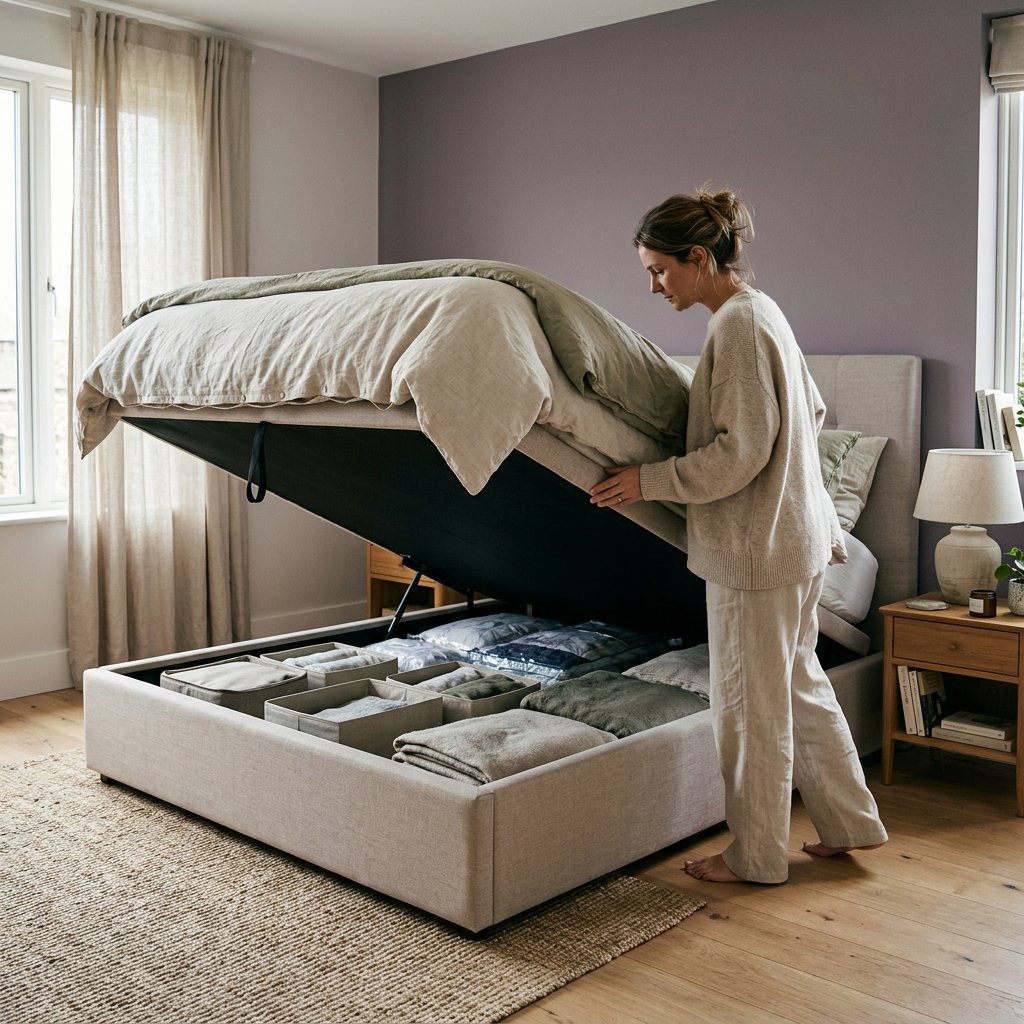
A storage bed only works well if there’s enough clear space around it. That sounds obvious, but it’s often underestimated. For drawers you need space at the side or foot end to pull them fully open. If the bed is close to a wall, wardrobe, radiator or nightstand, you lose some of that convenience right away. A lift-up model also needs working space: you should be able to stand in front of it or beside it and have enough room to open it without squeezing. Especially if you want to set up your bedroom smartly with limited space, a solution that saves space on paper can end up feeling impractical.
-
Where you place the bed in the room makes a big difference. A bed with one side against the wall is less suited to drawers on both sides. It sounds minor, but in daily use it quickly gets frustrating if you can only reach your things from one side. Placement also matters for lift-up versions. Against a slanted wall, under a low window or in a tight corner, opening can be trickier than you expect. A storage bed needs more coordination with your room layout than a regular bed frame or a simple box spring.
-
Another downside is the extra weight. A storage bed has more materials, a sturdier frame and often hinges, gas springs, slats or drawer runners. That makes the bed heavier and harder to move. It’s inconvenient when moving house, but you’ll notice it with everyday chores too. Rearranging the room, vacuuming properly behind the headboard or cleaning the floor under the bed often takes more effort. Some models even need to be partially emptied before you can move them safely. If you like to keep your bedroom layout flexible, that can feel like a clear drawback.
-
Hidden storage is especially handy for things you don’t need every day. Think guest duvets, winter gear or extra bedding. For everyday items it often works less well. If you have to grab something from the bed every morning or evening, opening it quickly turns into an extra step you start to dread. That’s especially true with a lift-up system, but drawers are also less practical if you need them often and always have to clear some space. For frequently used items, a regular wardrobe, open shelf or dresser is usually faster and more straightforward than storage under your mattress.
-
The height of the bed also deserves attention. Whether a high or low bed is better depends on your preferences and situation. A higher bed feels easier to get in and out of for many people and often leaves more room for storage under the sleeping area. At the same time, a tall, solid bed can make a small room feel fuller. A lower bed often looks calmer and more spacious, but offers less storage volume and can be less practical if you prefer to sleep a bit higher. So don’t choose on style alone. Look at how the bed makes the room feel and how comfortable it is in daily use.
-
Which brings us to the key point: a bed with storage isn’t automatically convenient just because it adds extra space. It also has to fit the way you live. If your bedroom is compact, you use the storage a lot and you want to clean or move things quickly, the downsides weigh more heavily. If you mainly need a spot for items you grab once in a while, hidden storage can work perfectly. So the difference isn’t only in the amount of storage, but in the mix of room layout, how often you use it, and ease of use.
Drawers or lift-up? The difference is bigger than you think
Not every storage system has the same limitations. If you’re considering a bed with storage, don’t just look at the liters. Focus on how the system actually works in everyday life.
-
Drawers are usually the fastest to use. Pull them open, grab what you need, slide them shut. That makes them great for items you reach for relatively often. The downside is they need clear side space. In a narrow room or next to a nightstand, that’s a real limitation. Drawers are also less suited to large, tall, or awkwardly shaped items. The layout is neat but limited: if it isn’t flat enough, it simply won’t fit well.
-
A lift-up base makes full use of the space under the mattress and often works better if the bed sits close to a wall. You don’t have drawers sticking out. That’s practical when you need lots of volume, like for extra duvets or storage boxes. The flip side is that the system feels heavier to use. Even if the opening is well supported, you’re still handling both the mattress and the base. For daily use, many people find that less convenient than they expected.
-
Open cubbies or integrated shelves are a lighter form of storage. Handy for books, small baskets, or things you like to keep within reach. They usually don’t have the mechanical downsides of drawers or a lift-up system. Still, they aren’t a full replacement for hidden storage. Everything stays visible, dust settles faster, and they’re usually less suited for seasonal storage. If you care about a calm-looking bedroom, open cubbies can start to feel cluttered quickly.
-
The best choice depends less on “what can I fit in there?” and more on “how often do I need to get to it and how much hassle am I okay with?”. Drawers are great for quick access, but they need more space next to the bed. A lift-up design uses space more cleverly, but it takes more effort and more trust in the mechanism. Open cubbies are simple, but less discreet. That practical difference is exactly what decides whether a storage bed stays pleasant long after the first purchase excitement wears off.
Comfort, ventilation, and maintenance: here’s the real difference
Lots of people wonder if a storage bed sleeps less comfortably. By itself, that doesn’t have to be the case. Sleep comfort mainly depends on the mattress, the topper, the support, and how well the whole setup matches your body and preferences. So a storage bed isn’t automatically less comfortable than a standard bed. What does matter is that the frame is solid and that the support under the mattress stays reliable, even with a storage system underneath.
Where you’ll notice a difference sooner is ventilation. Closed storage under the bed limits airflow around the mattress and textiles more than an open design. That doesn’t have to be a problem, but it does mean dry storage and regular airing become more important. So avoid putting damp items under the bed, and make sure bedding is clean and completely dry before you store it. Regularly ventilating the bedroom also helps keep the sleep climate fresh.
A storage bed also has more wear points than a simple bed frame. Think hinges, gas springs, slats, drawer runners, and mounting points. With heavy use or less careful assembly, these parts tend to need attention sooner. A drawer that runs crooked or a mechanism that opens less smoothly isn’t a major defect, but it does affect daily use. Because you rely on moving parts, quality matters more here than with a simple bed without extra features.
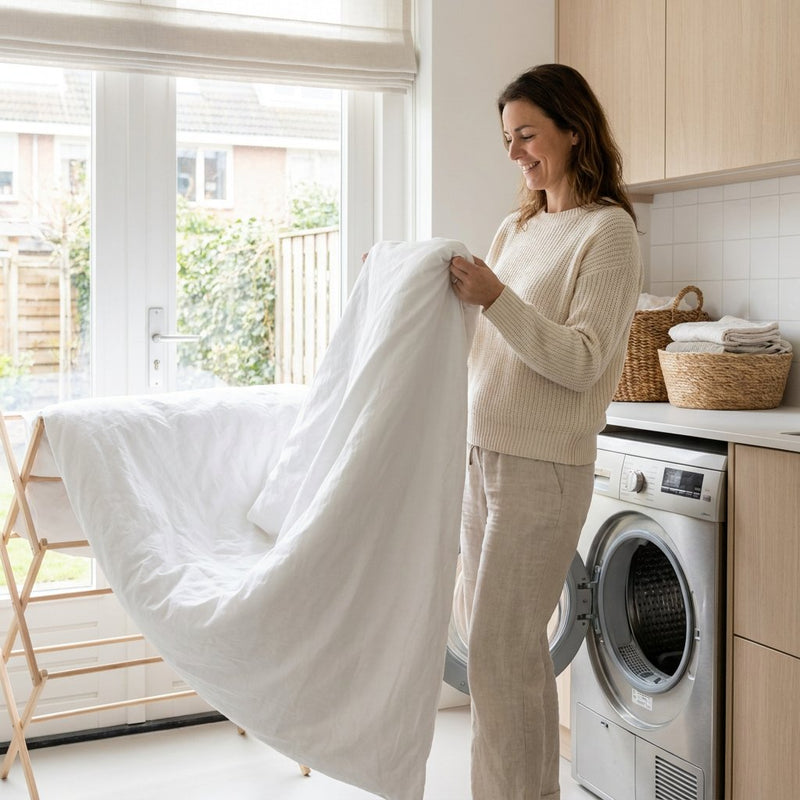
Cleaning also takes a bit more discipline. With open space under a bed, you spot dust faster and can usually reach it more easily. With closed storage, you notice dust, moisture, or early wear less quickly. That’s why it’s smart to empty the storage now and then, air it out, and check the moving parts. If you like to keep bedroom maintenance simple, this can be a sticking point. Same goes for bedding: the easier it is to keep fresh, the less work your whole sleep setup needs. That’s exactly why many people choose low-maintenance bedding alongside a practical bed, like a coverless, machine washable duvet from HappyBed, especially if they want to save space at home with a duvet that doesn’t need a cover.
Price and lifespan: what exactly are you paying for?
A storage bed usually costs more than a similar model without storage, and there’s a good reason for that. You’re paying not only for extra space, but also for a sturdier frame, more materials, extra hardware, upholstery, and a more complex build. With a storage box spring, there’s often the added requirement that the bed isn’t just comfy and stable, but also opens safely and smoothly. That simply makes design, production, and assembly more involved.
If you’re wondering what a good box spring costs on average, read more in What does a box spring cost?. Size, mattress build, topper, upholstery and finish make a big difference. One thing almost always holds true: if you compare two models at a similar level, a storage box spring is clearly pricier than a regular box spring. The markup mainly comes from the extra framework and mechanism. So it’s smarter not to look for one average price tag, but for the difference between a comparable model with and without storage.
With cheaper models you can often see where manufacturers had to cut costs. That might be thinner materials, less robust drawer runners, simpler hinges, or a basic finish that wears faster. For a piece of furniture you use every day, that really matters. A storage bed that seems smartly priced at first can be less pleasant over time if drawers start catching, the mechanism gets stiffer, or the structure feels less stable. So lifespan depends not only on how often you sleep on it, but also on how often you actively use the storage.
That’s why it pays to think not just about the purchase price, but also about real-life value. Does the bed truly replace a closet or dresser? Then the extra investment can make sense because you save space elsewhere. If the storage is mostly a nice-to-have and you expect to stash something there only now and then, the premium is harder to justify. In that case you’re paying relatively much for a feature you might barely use.
The smartest trade-off is usually pretty down to earth: are you paying for storage you truly need, or for an idea that just sounds appealing? The more often the storage solves a real problem, the easier it is to justify the extra cost. The less clear that benefit is, the more likely a simpler bed will be the better choice financially and practically.
Regular bed, box spring or storage bed: what suits you?
The choice gets easier once you understand the basic difference. A regular bed usually has a bed frame with a bed base and a mattress. Box springs typically have an upholstered base with a mattress on top and often a topper, which gives a higher entry height and a different look. A storage bed isn’t a completely separate type, but a variation where storage is added to a bed frame or box spring. Torn between two basics? Read Box spring or bed frame for the key differences. The best choice doesn’t come down to one trend, but to your budget, room layout, need for extra storage, how often you’ll access it, and how much maintenance you’re okay with.
| Selection criterion | Regular bed | Box spring | Bed with storage |
|---|---|---|---|
| Build and feel | Usually a separate frame with bed base and mattress. Simple, functional and often easy to tweak with a different mattress or base. | Upholstered base with mattress and often a topper. Looks fuller and higher, and feels more luxurious or finished for many people. | Can be based on a regular bed or box spring, but adds drawers or a lift-up system. More practical on paper, more complex in use. |
| Best choice if | You mainly want a simple, flexible and accessible solution without extra parts or mechanisms. | You value comfort, looks and a higher entry height and prefer simplicity without hidden storage. | You really lack storage space and items under the bed get a fixed, logical spot. |
| Less smart if | You don’t have much closet space and want to store a lot under the bed. | You mainly want extra storage volume or you have a limited budget for the entire bedroom setup. | Your bedroom is tight, you need your stuff often or you don’t feel like extra maintenance and moving parts. |
| Budget | Often the most straightforward choice, especially if you already have a good mattress or want to mix and match parts. | Usually pricier than a standard bed due to construction and finish, but without the extra cost of storage mechanisms. | Usually the most expensive in a comparable build, since you pay for frame reinforcement, hardware, mechanism and complex installation. |
| Room layout | Works in almost any bedroom, even if the bed is against a wall or you want to rearrange the room later. | A great fit for rooms where comfort and looks come first and you don’t rely on hidden storage. | Needs more attention to walking space, wall distance and the position of nightstands, doors and wardrobes. |
| Access to your stuff | Only possible with separate storage boxes under the bed if there’s space. Less integrated, still simple. | Not meant as a storage unit. It’s mainly about sleep and comfort, not storage. | Handy for items you grab now and then. Less handy for things you need every day, especially with a lift-up system. |
| Maintenance and cleaning | Usually the easiest. Fewer parts means less wear and fewer things to check. | Relatively simple, though the upholstery sometimes needs a bit of extra care. No drawers or hinges to keep an eye on. | Requires more discipline: airing out, checking for dust and inspecting moving parts are more likely part of the routine. |
| Moving or relocating | Often lighter and easier to disassemble or shift when cleaning or rearranging. | Can be large and heavy, but usually has fewer fragile moving parts than a storage model. | Often the least practical. The higher weight and extra construction make moving and disassembling harder. |
| Look in the room | Can look airy and calm, especially with a slimmer frame or lower model. | Often gives a warm, full and more luxurious look, with a clear presence in the bedroom. | Often looks a bit bulkier. That can be neat and sleek, but in a small room it can also come across as heavy more quickly. |
| Best fits you if... | You’re thinking: I want a bed that just works well, is easy to keep clean and doesn’t add more hassle than needed. | You’re thinking: I mostly want to lie comfortably and have a bedroom that feels calm and tidy, without extra storage mechanisms. | You’re thinking: without that hidden storage I’ll lack space, and I accept extra weight, price and maintenance. |
Which bed you should choose mostly depends on your priorities. If you mainly need extra storage and you use that space smartly for things you don’t grab every day, a storage bed can be a logical choice. If you want simplicity, easy cleaning and a bed that’s less dependent on surrounding space or moving parts, a regular bed or box spring is often nicer. And if you’re torn between style and convenience, it’s smart to first look at your bedroom layout and daily routine, then consider the extra storage compartment. If you want to compare non‑storage alternatives on price, height and ease of getting in and out, check out All beds.
Want less hassle in the bedroom but prefer no extra mechanics under your mattress? Sometimes the win isn’t in the bed itself, but in how easy it is to maintain your sleep environment. Think bedding that’s quick to make and wash. That’s exactly the idea behind HappyBed: making sleep comfort easier without adding unnecessary steps to your daily routine, even if you still want to compare Amour beds with storage.