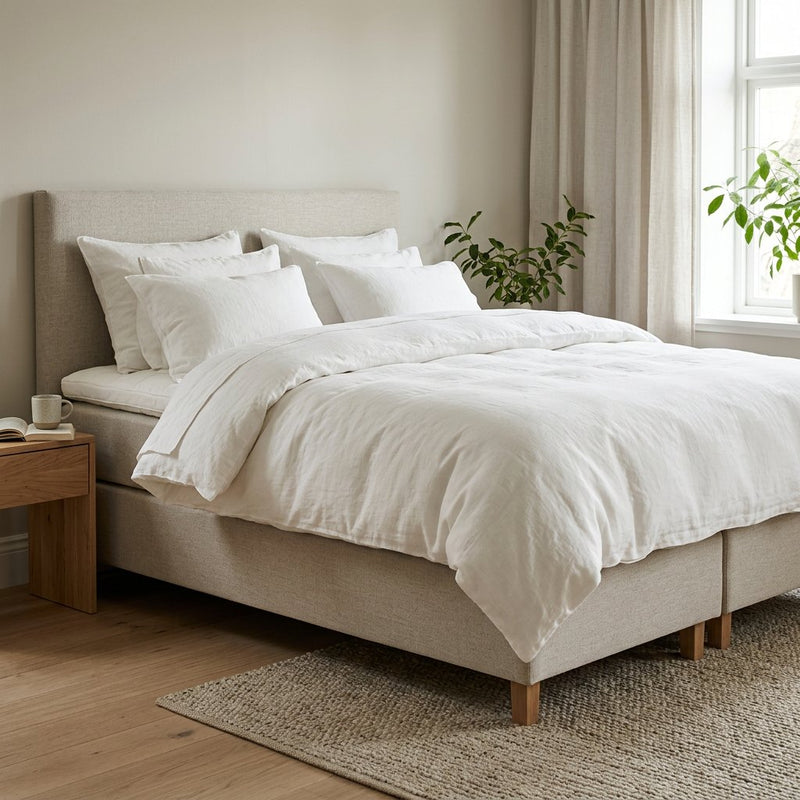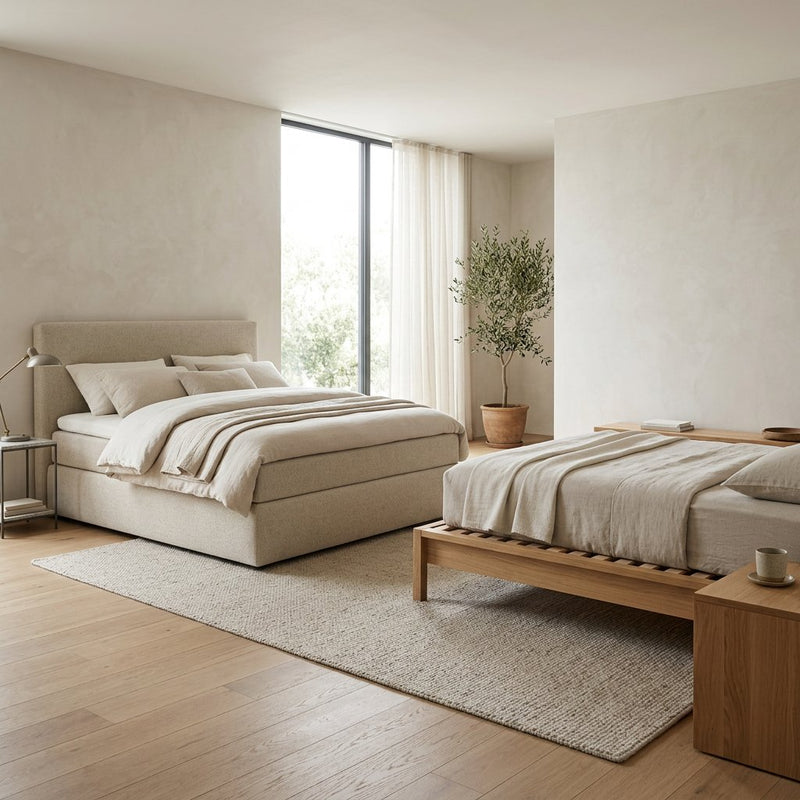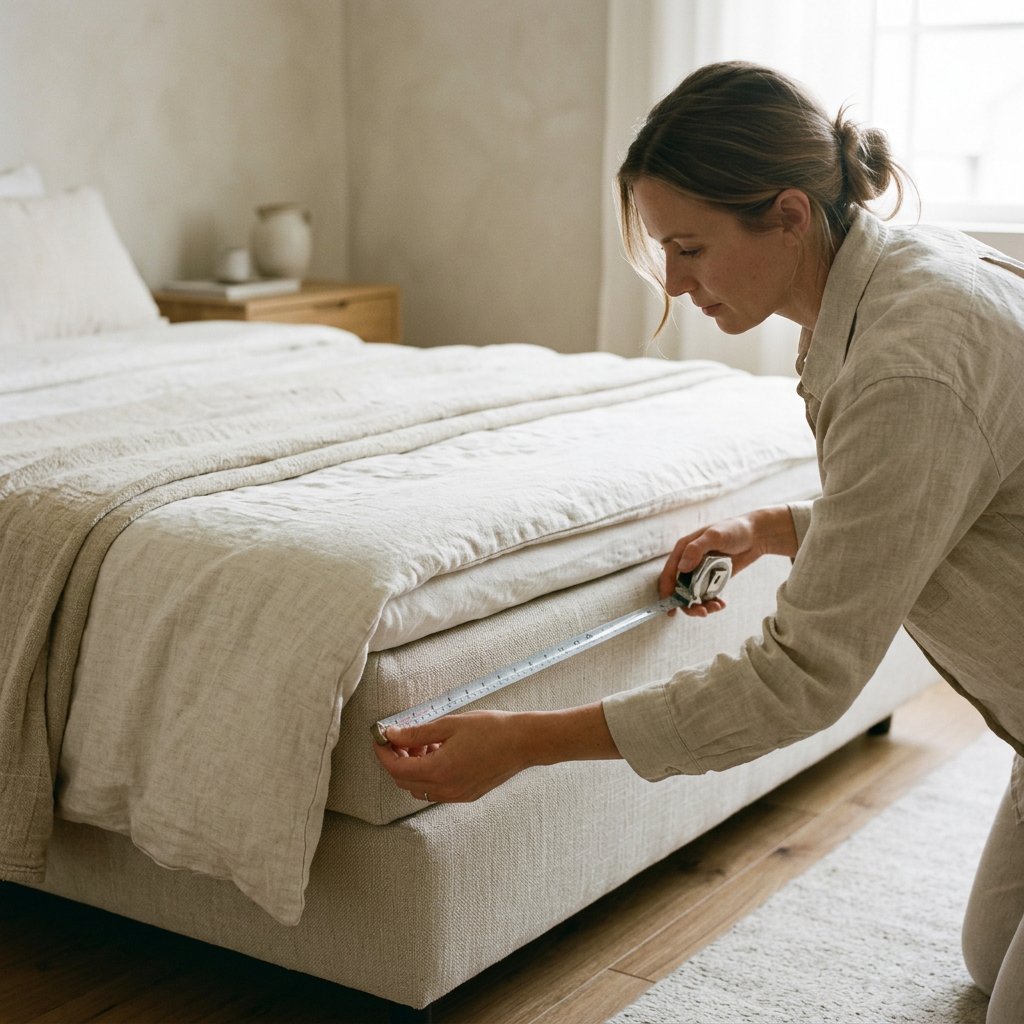

For one person, 80 or 90 cm are usually the safest picks. If you sleep as a pair, 160 and 180 cm are the common widths, while 200 cm is mainly interesting if you want extra space. In length, 200 cm is often standard, but 210 or 220 cm will feel better for taller sleepers.
The right size isn’t just about sleeping comfortably. You also want to keep enough walking space in the bedroom, make sure the box spring can get in through the door or up the stairs, and decide whether you prefer one large mattress or two separate mattresses with a topper.
With this practical guide you’ll quickly see which size makes sense for your situation. After that, we’ll also explain how to choose the right size box spring fitted sheet, topper fitted sheet or split-topper fitted sheet. Want to compare sizes and models right away? Browse box springs.
The standard sizes of a box spring in the Netherlands
| Size category | Common dimensions | Who does this make sense for? |
|---|---|---|
| Single | 80 x 200/210/220 cm or 90 x 200/210/220 cm | The standard for one sleeper; 90 cm gives a little more freedom to move than 80 cm. |
| Roomy single | 100 x 200/210/220 cm | For one person who likes a bit more room and has the space for it. |
| Small double | 120 x 200/210/220 cm or 140 x 200/210/220 cm | For one person who wants extra space, or as a compact in-between size for a smaller room. |
| Standard double | 160 x 200/210/220 cm or 180 x 200/210/220 cm | The most chosen sizes for two people; 180 cm clearly feels roomier. |
| Extra wide | 200 x 200/210/220 cm | For two sleepers who want maximum space and have enough room in the bedroom. |
Pay close attention to the exact centimeters. Sales names like queensize or kingsize aren’t used the same everywhere, while a size like 160 x 200 cm instantly shows what you’re getting.
Pick the width that fits who’s sleeping in it
You feel the width of a box spring every night. The narrower the bed, the less freedom to move you have and the faster you’ll notice each other turning or getting up. That’s why the choice doesn’t start with a sales name, but with your sleep situation: do you sleep alone, do you want to sleep compactly in a smaller room, or are you looking for lots of space for two? Going wider often brings more comfort, but also takes more floor space. Plus, larger box springs, mattresses and matching bedding are usually pricier. So don’t automatically go as wide as possible, go as wide as feels comfy and practical.
For 1 person: why 80 or 90 cm usually works well
For one person, 80 and 90 cm are usually the most logical widths. They give a nice balance between sleep comfort and free space to walk or place furniture in most bedrooms. A 70 cm bed will feel narrow for many adults, especially if you toss and turn a lot. If your room has a bit more space, 100 cm gives noticeably more freedom to move. That’s comfy and roomy for one sleeper. For two adults, 100 cm is generally too narrow in practice, even if it just about works on paper.
Three quarter bed: when 120 or 140 cm is a smart in between size
A three quarter bed of 120 or 140 cm is especially handy if you sleep alone but like lots of space. It can also be a smart middle ground in smaller bedrooms when 160 cm is just a bit too big. For two people, a three quarter bed is usually a compromise: it can work for a while, but for everyday use it often feels tight. Between the two sizes, 140 cm clearly offers more comfort than 120 cm, though it’s still less spacious than a standard double width of 160 cm or wider.
For 2 people: should you choose 160, 180 or 200 cm?
For two people, 160 cm is usually the practical baseline. That gives you roughly 80 cm each, similar to two single widths side by side. At 180 cm you get about 90 cm per person, which sleeps noticeably roomier and often reduces how much you feel each other’s movements. A 200 cm wide box spring offers maximum freedom to move and feels extra generous. There is a trade off though: the wider the bed, the less floor space you keep, and the bigger and often pricier the mattresses, toppers and fitted sheets become. So pick the width that fits both your sleep style and your room.
The right length keeps you from feeling cramped
The standard length for a box spring is usually 200 cm. That isn’t the best choice for everyone though. A simple rule of thumb is to add about 20 cm to the height of the tallest sleeper. So if someone is 1.82 m, 210 cm will often feel better than 200 cm. A bed that’s too short feels cramped faster than you might think, especially when a pillow takes up space or there’s a tall headboard or footboard. If you’re torn between two lengths and the room allows it, longer is usually the more comfortable pick. If you choose 220 cm, check out our Bedding for 220 cm length.
Keep enough walking space around the box spring
- Along the walking side, aim for about 50 to 60 cm of free space. It makes getting in and out and making the bed much nicer.
- Allow about 50 to 60 cm at the foot end too, so you can walk through and don’t block drawers or closet doors.
- Include nightstands, swinging closet doors, pull-out drawers, radiators and a thick headboard in the real space you need.
- Tape the bed’s dimensions on the floor. This helps you see in advance how big the box spring will feel in the room.
Measure the door, hallway and stairs before you order
It’s usually not the mattress but the box or base that’s the biggest challenge on delivery. It’s less flexible and harder to maneuver.
- Measure every doorway the bed has to pass through, including width and height.
- Check hallways, recesses and corners. A tricky turn can be more decisive than a straight passage.
- Measure stair width, turns, handrail clearance, ceiling height above the stairs and the diagonal space to tilt parts.
- See if the box spring comes in separate parts or can be split. That often prevents a lot of practical delivery issues.
- Check in advance whether assembly in the room is possible or needed, so you don’t find out on delivery day that the biggest part won’t go upstairs.
One large mattress or two singles? Also think about the topper and height
With a box spring, the base, mattress and any topper need to match exactly in width and length. The sleep surface should fit neatly without parts sticking out or being too narrow. One large mattress looks clean and seamless, while two separate mattresses can be more practical if partners prefer a different firmness or body support. Separate parts are often easier to transport too. Depending on the setup, a topper or split topper can be a smart add-on. Measure your split topper the right way. Don’t forget total bed height either: base, mattress, topper and legs together decide how high you get in, and whether you need extra high box spring fitted sheets.
Which fitted sheet size fits a box spring?
- Always go by the exact width and length in centimeters, for example 160 x 200 or 180 x 210, not terms like king size.
- Also measure the height of your mattress or topper so you can Determine the right pocket height for your box spring fitted sheet. Otherwise, the sheet will pop off more easily.
- If you don’t have a separate topper, a properly sized box spring fitted sheet for the mattress will usually do the trick.
- If you do have a separate topper, choose a topper fitted sheet. For a split topper, go for a split-topper fitted sheet.
- When you browse HappyBed’s range, always double-check the exact size for each box spring fitted sheet, topper fitted sheet, or split-topper fitted sheet.
- Do you have an adjustable or electric box spring? Check out the range of Fitted sheets for electric box springs in the right sizes.
Doubting between a box spring and a slatted base?
A box spring often has a higher entry and a more built-up, upholstered look. A slatted base usually looks more minimal and is often easier to build modularly. Which is better depends on the situation. Comfort preferences, desired entry height, look, ventilation, and budget all play a role. The size choice in centimeters works largely the same for both bed types, but due to the height and construction, a box spring often feels more present in the room.
This is how you choose the right box spring size step by step
- First decide how many people sleep in it daily. That usually gives you the right width category: 80 or 90 cm for one person, 120 or 140 cm as an in-between, and 160, 180, or 200 cm for two.
- Then look at the height of the tallest sleeper and ideally add about 20 cm.
- Next, measure the bedroom itself, including walking space along the sides, the foot end, and any furniture that opens or sticks out.
- Then check the access route: door, hallway, turns, stairs, and any in-room assembly.
- Lock in the setup last: one or two mattresses, with or without a topper, total bed height, and the right size fitted sheet. Always check the exact product size in centimeters before ordering.